King, High Priest, Forever: Session One
The Book of Hebrews lays out some deep theology regarding Jesus as our King and ultimate High Priest over the household of God. This series goes into the book of Hebrews in a deep way, uncovering the Old Testament connections with depth you probably were unaware was even there.
Today, we're looking only at the first chapter of Hebrews, to see what references we can unravel, and cover some background regarding which translation the author was using.
Scripture to Read: Hebrews 1:1–14
It's only 14 verses, but in those 14 verses, the author of Hebrews makes 7 references to the Old Testament, all relevant to his point and deeper than you think. For starters, let's just read the passage and try and understand what the Author's point is they are trying to make.
Hebrews 1:1–14 (ESV)
The Supremacy of God’s Son
1 Long ago, at many times and in many ways, God spoke to our fathers by the prophets, 2 but in these last days he has spoken to us by his Son, whom he appointed the heir of all things, through whom also he created the world. 3 He is the radiance of the glory of God and the exact imprint of his nature, and he upholds the universe by the word of his power. After making purification for sins, he sat down at the right hand of the Majesty on high, 4 having become as much superior to angels as the name he has inherited is more excellent than theirs. 5 For to which of the angels did God ever say,
              “You are my Son,
  today I have begotten you”?
Or again,
              “I will be to him a father,
  and he shall be to me a son”?
6 And again, when he brings the firstborn into the world, he says,
“Let all God’s angels worship him.”7 Of the angels he says,
              “He makes his angels winds,
  and his ministers a flame of fire.”
8 But of the Son he says,
              “Your throne, O God, is forever and ever,
  the scepter of uprightness is the scepter of your kingdom.
        9       You have loved righteousness and hated wickedness;
              therefore God, your God, has anointed you
  with the oil of gladness beyond your companions.”
10 And,
              “You, Lord, laid the foundation of the earth in the beginning,
  and the heavens are the work of your hands;
        11       they will perish, but you remain;
  they will all wear out like a garment,
        12       like a robe you will roll them up,
  like a garment they will be changed.
              But you are the same,
  and your years will have no end.”
13 And to which of the angels has he ever said,
              “Sit at my right hand
  until I make your enemies a footstool for your feet”?
14 Are they not all ministering spirits sent out to serve for the sake of those who are to inherit salvation?
What is the point being made?
Here, the Author of Hebrews is drawing a few references to show the reader that the Prophets spoke of this future coming, explaining the role Jesus has in it all.
He starts by establishing His viewpoint on Christ: He's the Heir over creation, He's the exact imprint of God, He created the universe and upholds it. This Son of God, who is superior to the Angels, is Jesus who came to purify us of our Sins. Once He had purified us, He sat down at the right hand of "The Majesty on High" who we can understand to be The Father, until His second coming. The Next few references, then, are intended to prove the Author's point.
A Note Regarding quotations made
Before I proceed, I would like to preface the rest of this study with a note that may shock some people: The Author of Hebrews was more than likely quoting from the Greek translation of the Old Testament. In 2026, it's known colloquially as the "LXX" or Septuagint, but this is not a historical name for the Greek Scriptures. Historically, the "Septuagint" usually refers just to "the Law" (probably the Torah only) that had been translated at Alexandria for Ptolemy II (reigned from 285 to 247 BC) which was shortly after Alexander the Great had Hellenized much of the known world. Ptolemy I, his father, was the Macedonian general of Alexander, and he founded the Dynasty that Ptolemy II inherited. In my own head cannon, I'd like to think his inspiration for wanting to translate the Law came from the prophecy fulfillment by Alexander in Daniel 8 being fulfilled in Ptolemy's own lifetime.
This "Old Greek" translation was carried forward in a few different forms by Jews of the era, who used it in some form along with other Greek Translations of Old Testament books, and was the basis that many of the New Testament authors quoted from. I may refer to the entirety of the Greek Scriptures as the LXX to shorten the name, but please keep in mind they were not all translated at one time, or by the same groups.
Some of the scripture is taken from the St. Athanasius Academy Septuagint™. Copyright © 2008 by St. Athanasius Academy of Orthodox Theology. Used by permission. All rights reserved. This is found inside the "Orthodox Study Bible" with the NKJV attached for the New Testament, and is the translation I have been using for my study of the Greek Old Testament. All emphasis added to quotations is done by me.
Why Should I care?
This is not merely a matter of scholarly disagreement or academic curiosity. Paul himself treated the singular form of the word seed in God's promise to Abraham as a significant theological point. In Romans and especially Galatians, he builds part of his argument on that grammatical detail. If the singular form of a single word was important enough for Paul to make it a key part of his reasoning, how much more should we pay attention to larger textual differences where entire words, phrases, or clauses have been added, omitted, or rearranged?
Hebrews 1:5
The first few references are to establish a few points:
- Jesus is not an Angel, but the Son of God
- The Angels even Worship him
- We and the Angels are His Ministers.
Let's dig deeper and see what the Author is saying
vs. 5 has two references, the first is from Psalm 2:7 and the second from 2 Samuel 7:14.
Let's grab both of those passages and read them, to make sure we know what's going on.
Starting with Psalm 2
Psalm 2:4–9 (ESV)
        4       He who sits in the heavens laughs;
  the Lord holds them in derision.
        5       Then he will speak to them in his wrath,
  and terrify them in his fury, saying,
        6       “As for me, I have set my King
  on Zion, my holy hill.”

        7       I will tell of the decree:
              The LORD said to me, “You are my Son;
  today I have begotten you.
        8       Ask of me, and I will make the nations your heritage,
  and the ends of the earth your possession.
        9       You shall break them with a rod of iron
  and dash them in pieces like a potter’s vessel.”
Here we have God saying he set his King David on Zion, and then David shares the decree that the Lord has made regarding his kingship, but it's also messianic prophecy too.
If the Author of Hebrews is quoting this, then this section makes a lot more sense if you read the Greek version. The following is from my Greek Old Testament translation of Psalm 2
Psalm 2:4-9 (SAAS)
4 He who sits in the heavens shall laugh at them; The Lord shall mock them. 5 Then shall He speak to them in His wrath And trouble them in His anger, 6 “But I was established as King by Him Over His holy hill of Zion, Declaring the Lord's decree. 7 The Lord said to Me, ‘You are My Son, Today I have begotten You; 8 Ask of Me, and I will give You The nations for Your inheritance And the ends of the earth for Your possession. 9 You shall shepherd them with an iron staff; You shall shatter them like a potter's vessel.’ ”
In the Greek, we have He who sits in the heavens, who says He was established as King over Zion by Him (plurality), and that King (who is called The Lord in Psalm 2:4-5!) says that the Lord said to Him: "You are my Son, Today I have begotten you" and that's exactly what the Author of Hebrews point was that they were making: Jesus is the Son of God, who was established as King over Zion by The Father, and begotten by The Father. What else does the Lord say to that King: He tells Him that the Nations are His Inheritance and that He will shepherd them. These are exactly what Jesus claims to do from the New Testament.
Now the King was not King before he was begotten, and what is "Today" if not a day determined in our history. Being "Begotten" is actually an old word that doesn't just mean birth, but also to "Bring Forth" something of the same nature as yourself. We as Humans beget children, God the Father Begot Jesus before time, a point the author of Hebrews makes by establishing that the world was made through the Son, something we will discuss more later.
The Second Reference from 2 Samuel 7, is said to David about his son Solomon who would become King over Israel, but it's also messianic according to the Author of Hebrews. Sadly, it also makes less sense in the Hebrew Old Testament. If the Author of Hebrews is referencing 2 Samuel 7:14, the Hebrew OT says "When he commits iniquity" which is not applicable to Jesus. The Greek translation, however, has "If" there making it safe to apply to Jesus.
2 Samuel 7:12–14 (ESV)
12 When your days are fulfilled and you lie down with your fathers, I will raise up your offspring after you, who shall come from your body, and I will establish his kingdom. 13 He shall build a house for my name, and I will establish the throne of his kingdom forever. 14 I will be to him a father, and he shall be to me a son. When he commits iniquity, I will discipline him with the rod of men, with the stripes of the sons of men,
vs.
2 Samuel 7:12–16 (SAAS)
12 And it shall come about, when your days are fulfilled and you rest with your fathers, I will raise up your seed after you, who will come from your body, and I will prepare his kingdom. 13 He shall build a house for My name, and I will establish his throne forever. 14 I will be a father to him, and he shall be to Me a son. And if he commits iniquity, I will chasten him with the rod of men and with the blows of the sons of men. 15 But I will not take My mercy from him, as I took it from those whom I withdrew from My presence. 16 And his house will be made sure, and his kingdom shall be forever.”’
If we take the Greek reading, this can safely be applied to Jesus, and since He carried our iniquities, He was chastened with the rod of men for our sins, it's even making the point that Hebrews also, God's Mercy did not depart from Jesus, and He purified us to be in His presence, establishing a House for the living God inside all believers.
Hebrews 1:6
Now if you didn't believe me that the Author of Hebrews was using the Greek scriptures yet, let's take a look at the next few references.
Verse 6 starts out saying that when God brought the firstborn into the world, he said "Let all God's angels worship him". Some Bibles may place a reference to Psalm 97:7 there, I think that's a loose reference, and the actual cross-reference is Deuteronomy 32:43
The Hebrew Old Testament entirely lacks the reference made in this verse from Deuteronomy 32:43, but is present in the LXX, and the Dead Sea Scrolls.
Deuteronomy 32:43 (ESV)
        43       “Rejoice with him, O heavens;
  bow down to him, all gods,
              for he avenges the blood of his children
  and takes vengeance on his adversaries.
              He repays those who hate him
  and cleanses his people’s land.”
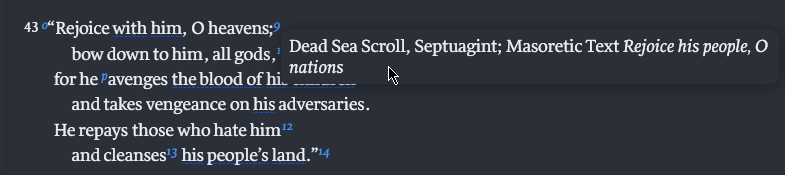
Some Bibles make an attempt to restore the reference, as you can see with the ESV below inserting bow down to him, all gods, unfortunately due to this type of formatting, I cannot add emphasis above, but that line is added using the Dead Sea Scroll reading.
Now let us compare this attempt to restore the reference, to the Greek Scripture translation that retains two references to the Angels of God, and an additional reference made by Paul in Romans that's missing from both the DSS and the Masoretic Text. This time, it's not just the meaning that is changed from this reference, just look at how much longer the verse is supposed to be if we take Paul's quote in Romans into consideration:
Deuteronomy 32:43 (SAAS)
43 “Rejoice, O Heavens, together with Him, And worship Him, all the sons of God; Rejoice, O Gentiles, with His people; And let all the angels of God be strong with Him; For He will avenge the blood of His sons And render vengeance to His adversaries; And the Lord will purify His people's land.”
There are two whole lines that are entirely gone from the Hebrew (or two added in the Greek depending on how you view it)! What happened? Well, I personally think the reference for "bow down to him, all gods" was erased from the Masoretic text, with means, motive and opportunity. This is an opinion, please do not take this as scholarly or anything, but it's possible even that this was done to counter the references that the Author of Hebrews uses here to make his point. And the further addition attributed here from Paul made in Romans, this is just one of many other references that vanish mysteriously across the Old Testament that are attested to in the New Testament.
For example, here is the matching line that is quoted verbatim in Romans 15:10 that was missing entirely from the DSS. The reading is found in some form as the opening to verse 43 in the Masoretic Text with it often being footnoted in the case of the ESV as you can see in the image below from Logos Bible Software demonstrating how it's rendered there. They preferred the DSS reading but included the Masoretic Text as a footnote, showing that even today we are challenging our understanding of the true nature of scripture, and replacing pieces that we find more support from other witnesses for.
Romans 15:10 (ESV)
10 And again it says,
“Rejoice, O Gentiles, with his people.”
Both of these points lead us to conclude that: The Angels, and the Gentiles too are supposed to worship God. Both times this verse is quoted in the New Testament, it's contextually about Jesus as the Son of God regarding His worship as God to include both the Angels and the Gentiles. Curious that we find that the Hebrew text has erased both of these points that the New Testament authors were making from this particular verse.
Now the greater truths in Scripture still tell us these things — that the Angels and Gentiles will and do worship God — but the fact we have attested witnesses from New Testament authors to the inclusion of these words, or their deeper meanings themselves, and we find that has been altered or in this last case removed entirely from the Hebrew scriptures is a bit alarming to me. Here you can read the oldest Hebrew witness we have, the Dead Sea Scrolls, which had a fragmentary manuscript. Scroll 4Q44 Deuteronomy, retains "and bow down to him, all gods." which is the critical reference that the Author of Hebrews made from this passage, but lacks the "Rejoice, O Gentiles, with his people." that is found in the LXX and the Masoretic Text (albeit sanitized, since it's not "with his people", it just says "Rejoice O people, O Nations" adding some wierd form of separation I guess).
Some Scholars have posited that the LXX is actually a witness to a second Hebrew tradition of the Old Testament, and in some way that tradition became what we now know as the Masoretic Text, because "Rejoice, O Nations, with his people." is what we sorta find in the Masoretic Text at the start of this verse, but the older DSS witness has the first line as "Rejoice with him, O Heavens. The LXX retains both of these lines, albeit in a different order with the added line about the Angels. This is why they argue it's what became the Masoretic Text since it has all the data points included instead of pieces of it found in either the DSS or the Masoretic Text. The Author of Hebrews and Paul quoted from here including both of these readings, it's probable that the LXX it is the correct reading because of that.
Hebrews 1:7
That was A LOT to go through, and I'm going to pre-emptively apologize for later on because it will probably get more complicated as we go, but you'll be thankful to hear that this verse is not nearly as complicated, it's a direct quotation from the Psalms, and is not changed significantly in the Hebrew version of the Psalms.
Psalm 104:1–4 (ESV)
O LORD My God, You Are Very Great
104 Bless the LORD, O my soul! O LORD my God, you are very great! You are clothed with splendor and majesty, 2 covering yourself with light as with a garment, stretching out the heavens like a tent. 3 He lays the beams of his chambers on the waters; he makes the clouds his chariot; he rides on the wings of the wind; 4 he makes his messengers winds, his ministers a flaming fire.
The word "messengers" here is the word translated "angels" in the Greek and is a valid rendering on it. Notice something, the Author is quoting a passage where the Lord stretches out the heavens like a tent and lays the beams of his chambers on the waters. Something of note, the "waters" here is likely referring to Genesis 1:1 where the waters are created in the beginning. So we must understand, then, that the author of Hebrews is saying that Jesus is the one who is clothed with splendor and majesty here, since it is He who made the angels winds, and his ministers a flaming fire. How then, could the maker of Heaven and Earth be Himself one of those messengers in the same way? That's the point the author of Hebrews is about to make using this reference as a contrast that if God said this about the Angels, what does He say of the Son?
Hebrews 1:8-9
The very next section is now a contrast to the last, God made the Angels winds and his ministers a flaming fire, "but to the Son he says" and it quotes next from Psalm 45:6-7. Please note, the LXX numbering of the Psalms differs slightly, but this is Psalm 44 in the LXX, Psalm 45 in the Hebrew Bible. The verse numbering also starts at the title, instead of at the first verse here, so the numbers for verses increase by one in comparison. So below it's actually Psalm 44:7-8 for the LXX.
Before we even start, let us pay attention to the title even: "For the End, concerning things that shall be changed; to the sons of Korah for understanding;" (indicating their rebellion as I discussed in my last session), but it also opens up as an ode "concerning the Beloved One" who is Jesus.
Psalm 44 (45) (SAAS)
1 For the End, concerning things that shall be changed; to the sons of Korah for understanding; an ode concerning the Beloved One.†ω
My heart overflowed with a good word; I tell my works to the King; My tongue is the pen of a swift-writing scribe. 3 You are more beautiful than the sons of men; Grace was poured out on Your lips; Therefore God blessed You forever. 4 Gird Your sword upon Your thigh, O Mighty One, In Your splendor and Your beauty. 5 And stretch Your bow, and grant prosperity, and reign Because of truth, gentleness, and righteousness, And Your right hand shall guide You wondrously. 6 Your arrows are sharp, O Mighty One (The peoples shall fall under You), In the heart of the King's enemies. 7 Your throne, O God, is forever and ever; Your royal scepter is a scepter of uprightness. 8 You loved righteousness and hated lawlessness; Therefore God, Your God, anointed You With the oil of gladness more than Your companions. 9 Myrrh and stacte and cassia pour forth from Your garments, From the ivory palaces from which they gladdened You. 10 There are daughters of kings in Your honor; The queen stood at Your right hand in apparel interwoven with gold, And adorned and embroidered with various colors. 11 Listen, O daughter, behold and incline your ear, And forget your people and your father's house; 12 For the King desired your beauty, For He is your Lord. 13 And the daughters of Tyre shall worship Him with gifts; The rich among the people shall entreat your favor. 14 All her glory as the King's daughter is within, Adorned and embroidered with golden tassels. 15 The virgins behind her shall be brought to the King; Her neighbors shall be brought to You; 16 They shall be brought with gladness and rejoicing; They shall be led into the temple of the King. 17 In place of your fathers, sons shall be born to you; You shall make them rulers over all the earth. 18 They shall remember your name from generation to generation; Therefore, peoples shall give thanks to you Forever and unto ages of ages.
Bear with me, it's a bit long of a reference, but there are a few things: The King is the one who is being addressed, and it says that the king is God in vs 7, then it also says in vs 8. that "God, Your God" anointed the King? This sounds exactly like the earlier Psalm 2 reference, where we have The Father saying to the Son exactly like the author of Hebrews says it does that Jesus' throne is forever and ever.
The translation from the Hebrew Old Testament preserves most of the psalm, but differs slightly near the ending, and it's in a subtle way that also somewhat erases the favor the Gentiles will give to the Lord. In verse 13 from above, we have "the daughters of Tyre shall worship Him (the King) with gifts; The rich among the people shall entreat your (the daughter of the King) favor."
Look at verse 12 from the Hebrew rendition of this Psalm and tell me if you notice a subtle but significant detail, judge for yourselves what you think:
Psalm 45:10–12 (ESV)
        10       Hear, O daughter, and consider, and incline your ear:
  forget your people and your father’s house,
        11       and the king will desire your beauty.
              Since he is your lord, bow to him.
        12       The people of Tyre will seek your favor with gifts,
  the richest of the people.
It's no longer the people of Tyre (Gentiles) seeking to worship God with their gifts, it has been entirely addressed to the daughters now, and in a way where the Gentiles will basically be worshiping the daughters instead of our Great God and King who was anointed, and redeemed them also. This means that the Author of Hebrews' point falls flatter in the normal rendering, since the reference almost excludes the Gentiles from the blessings of being a member of the King's family, since they do not seek his favor, and do not receive the gifts like the entire passage implies.
Like before, the translators for the ESV have preserved the longer reading in a footnote
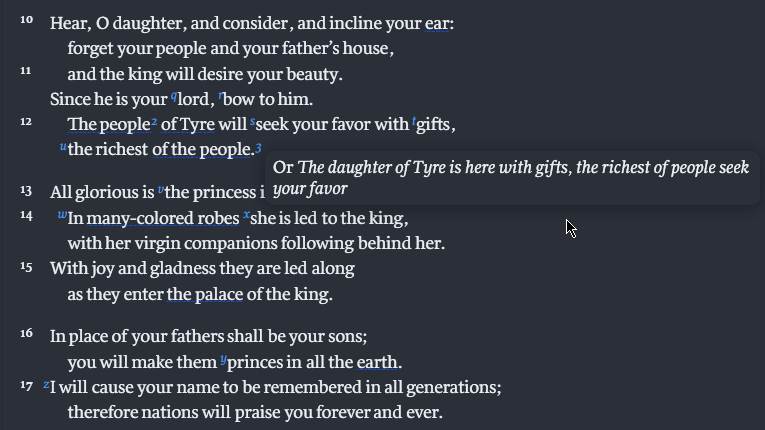
Albeit the main point is still valid, the side point is this: Daughters of Tyre, forget your people and your father's house. For the King (that is Jesus Christ) desires you, seek the Lord, bow down to Him, and you will be blessed. That's literally the Gospel, is it not? Mind you that blessing is not material, but eternal, and the fact the Psalm is titled "For the End" should clue you in that the blessing is not really earthly, and the imagery used is just that, imagery which is used to show you the greater heavenly reality. There are a lot more things to discuss from this Psalm (like Catholic/Orthodox apologists will quote verses 10-15 and apply them to Mary for example, following the Queen Mother antitype from Solomon's reign in 1 Kings:2:19) but I will move on since the Author of Hebrews has a lot more to say for us to unpack.
Hebrews 1:10-12
The next reference is also one to be understood as addressed to the Son from the Father, and again, this one really bothered me for a bit. It's quoting Psalm 102:25-27.
Reading the Hebrew Old Testament and saying that this verse is from the Father to the Son would be butchering what the Psalm really says there. The prayer could be understood as Jesus addressing the Father perhaps, but in the Greek it's actually pretty clear, and it makes perfect sense to say that it's the Father addressing the Son.
Psalm 102:11–28 (ESV)
        11       My days are like an evening shadow;
  I wither away like grass.
        12       But you, O LORD, are enthroned forever;
  you are remembered throughout all generations.
        13       You will arise and have pity on Zion;
  it is the time to favor her;
  the appointed time has come.
        14       For your servants hold her stones dear
  and have pity on her dust.
        15       Nations will fear the name of the LORD,
  and all the kings of the earth will fear your glory.
        16       For the LORD builds up Zion;
  he appears in his glory;
        17       he regards the prayer of the destitute
  and does not despise their prayer.

        18       Let this be recorded for a generation to come,
  so that a people yet to be created may praise the LORD:
        19       that he looked down from his holy height;
  from heaven the LORD looked at the earth,
        20       to hear the groans of the prisoners,
  to set free those who were doomed to die,
        21       that they may declare in Zion the name of the LORD,
  and in Jerusalem his praise,
        22       when peoples gather together,
  and kingdoms, to worship the LORD.

        23       He has broken my strength in midcourse;
  he has shortened my days.
        24       “O my God,” I say, “take me not away
  in the midst of my days—
              you whose years endure
  throughout all generations!”

        25       Of old you laid the foundation of the earth,
  and the heavens are the work of your hands.
        26       They will perish, but you will remain;
  they will all wear out like a garment.
              You will change them like a robe, and they will pass away,
        27       but you are the same, and your years have no end.
        28       The children of your servants shall dwell secure;
  their offspring shall be established before you.
A couple of things I want to point out, the declaration of the Lord's name (vs. 21) happens when he arises (vs. 11), and that the Nations will fear the name of the Lord as a result. This is exactly what happened with Jesus, He rose from the dead and now the Nations (Gentiles) fear His name.
Verse 25 lacks the "O Lord" or "Oh God" and now says "Of old" instead of what we see referenced from Hebrews 1. It appears it was shifted into verse 24 in the Masoretic text and the effect is a shift back to have the Man who was praying speaking again. Verse 26 (27 in Greek) also has a different wording at the end of it "they will pass away" versus "They shall/will be changed" from the DSS and LXX. Let's compare the Greek translation which has God replying to the man starting from vs 24 who is praying for most of the Psalm!
Psalm 101 (102):12-29 (SAAS)
12 My days were far spent like a shadow, And I am withered like grass. 13 But You, O Lord, remain forever, And Your remembrance is from generation to generation. 14 When You rise up, You shall have compassion on Zion, For it is time to have compassion on her, because the time is come; 15 For Your servants took pleasure in her stones, And they shall have compassion for her dust. 16 And the Gentiles shall fear the name of the Lord, And all the kings of the earth Your glory; 17 For the Lord shall build Zion, And He shall be seen in His glory. 18 He regarded the prayer of the humble, And He did not despise their supplication. 19 Let this be written for another generation, And the people who are created shall praise the Lord; 20 For He looked down from the height of His holy place; The Lord looked upon the earth from heaven, 21 To hear the groaning of those bound, To set free the sons of the slain, 22 To declare the Lord's name in Zion, And His praise in Jerusalem, 23 When the peoples and the kingdoms Are gathered together to serve the Lord. 24 He replied to Him in the way of strength, “Declare to me the fewness of my days; 25 Take me not away in the midst of my days; Your years are throughout all generations. 26 In the beginning, O Lord, You founded the earth, And the heavens are the works of Your hands. 27 They shall perish, but You shall remain, And all things shall grow old like a garment, And like a cloak You shall change them, And they shall be changed; 28 But You are the same, and Your years shall not fail. 29 The children of Your servants shall dwell there, And their seed shall be led to prosperity forever.”
I've highlighted the main difference between the Greek Psalm and the normal Hebrew in verse 24 as well as the quotation from Hebrews that's located in verses 26-28. If you would like a side by side comparison of the Masoretic Text, the KJV, and the Koine Greek: Wikipedia has it posted there, below I reference it with an alternate translation that may clear some confusion the Greek translation from the SAAS can introduce.
Hebrews 1:10-12 matches a lot closer to the Septuagint reading of the Psalm here, having "O Lord" in the correct place, and the reference from Hebrews actually starts to make sense because of the variation in verse 24 that has the rest of the Psalm as a reply to the Prayer. I also want to say that the reading is similar in the NKJV version of Hebrews 1 to the SAAS here, and it's different in the ESV because the words "cloak" and "robe" are exchanged to match to the Hebrew reading of the OT, and the second reference: "like a garment" that is present in the ESV translation of Hebrews 1, that second instance is omitted in some manuscripts of the book of Hebrews, the NKJV omits this, but it is included in the ESV; That omission brings the reading even closer in line with the LXX, Masoretic Text and the DSS.
When the peoples are gathered to serve the Lord, He (The Father) replied to Him (the main praying who gave this shocking picture of what Jesus experienced). Since the man praying just told the Lord in verse 13 that the Lord remains forever, this next bit where God asks the Man "Declare to me the fewness of my days; Take me not away in the midst of my days;" seems to be rhetorical since the Lord follows it up saying "Your years are through all generations" making it now a declaration of equality instead to the man praying.
There's also a potential difference in translation that could be done for verse 24, below is an image using Google's translate extension referencing the Greek from the above linked Wikipedia page. Here it has "He Declared to me the fewness of my days" making it even more so about how the Father is answering the Son's prayer here.
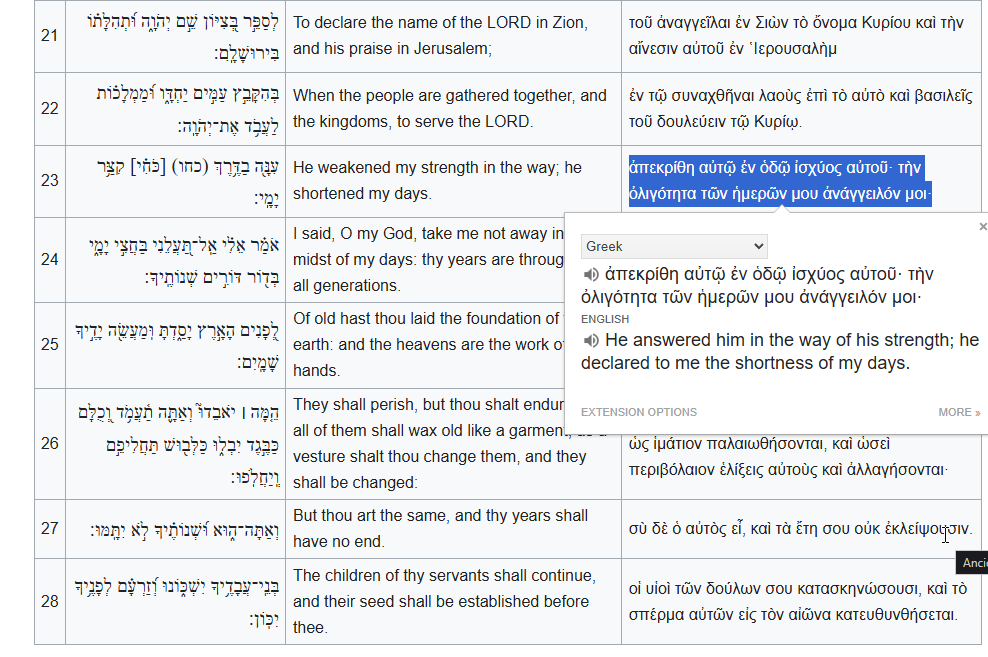
This makes complete sense when you consider the Author of Hebrews was saying that this part was The Father speaking to the Son, that equality makes perfect sense, then, if you consider that Jesus is that Son of God whom the Author of Hebrews is saying this is passage is spoken to. Even more so, The Father then continues to say that "In the beginning, O Lord, You founded the earth.", and take a look and see what point the Author of Hebrews made earlier in Hebrews 1:2 that through Jesus, God made the world. Contrast that to what He says to Job where God asks Job a similar question in verse 4, also rhetorically, but this time the answer is that Job was not there when the Earth was founded:
Job 38:3–7 (ESV)
        3       Dress for action like a man;
  I will question you, and you make it known to me.

        4       “Where were you when I laid the foundation of the earth?
  Tell me, if you have understanding.
        5       Who determined its measurements—surely you know!
  Or who stretched the line upon it?
        6       On what were its bases sunk,
  or who laid its cornerstone,
        7       when the morning stars sang together
  and all the sons of God shouted for joy?
Now something I heard recently was to try and picture Christ here as your advocate, standing between you and The Father, answering each of these questions posed to Job. If we take the SAAS translation, instead of the alternate I posed above — when God The Father asks Jesus to declare to him the fewness of His days or asks him to take him not away? The answer is "Forever, Father. Never, Father." and through His faithful supplication He was there when the Father made the world through Him. That's why the Father is saying to the Son: "In the beginning, O Lord, You founded the earth, and the heavens are the works of Your hands. Jesus can Answer those questions above posed to Job: "I was there Father, we determined its measurements. Its bases were sunk where we laid them, and we laid its cornerstone while the Angels praised our work."
What is a Cornerstone?
I want to take a quick detour to explain what a cornerstone is, since it comes up often in scripture. Below is an illustration I got from Pinterest with relevant scripture from Ephesians 2:19-22 that helps to illustrate how important the cornerstone is.
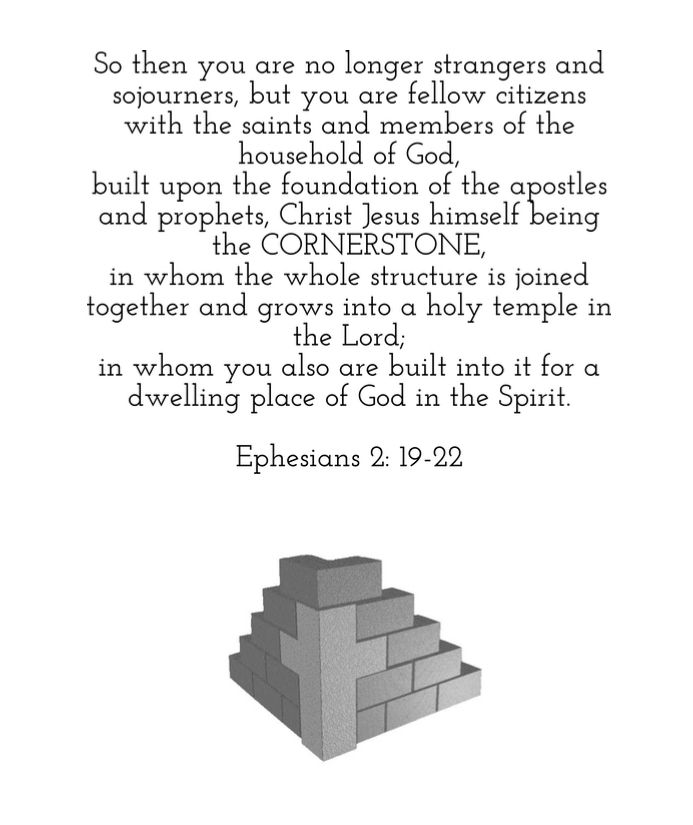
Could you imagine what would happen to that section of wall if you removed that cornerstone? It would probably crumble — It may not happen immediately, but when a storm came or the wind blows too hard, that house of cards will come tumbling down without the cornerstone.
That cornerstone laid from the foundation of the world is Jesus Christ, the Messiah. He planned to lay down his life to become the cornerstone the entire time, and on our behalf, He came to die for our sins, rose again on the third day, ascended to sit at the right hand of the Father, and He intercedes for us in lieu of the wrath we actually deserve. This is a point that the rest of the book of Hebrews will also establish, and we will also study deeper later on.
Hebrews 1:13-14
Finally, the Author of Hebrews wraps up the chapter with a question, rhetorical to us this time, to contrast what is said of the Son versus the Angels who are to serve and worship Him. Now if you are exhausted after those last few references, you will be grateful to hear that for this last reference we are not going to be looking at the Greek differences today (of which I will probably have much to say). The Hebrew translation from the Masoretic text is sufficient for today's purposes.
It's a short one this time, and it's one that Jesus himself quoted in His earthly ministry. It comes from Psalm 110:1, and the entire Psalm is about Jesus, the Author of Hebrews really likes this Psalm and will actually spend a lot of time on the middle passage of it, today we are not going to touch on that portion. The point being made right now is that God has not asked any Angel to sit at His right hand, He asked His Son. The rest of the Psalm, again, is referenced in later portions of the book so today we are just caring about the start really.
The Author of Hebrews then ends the first chapter stating that the Angels are "ministering spirits sent out to serve for the sake of those who are to inherit salvation". We see this as they deliver messages, and act in the divine council throughout the Old Testament, executing the will of God under His authority, but they are all subject to God in the end. The point now becomes clear: How can those who are to serve the ones who are being served, much less be the one who saves those who are to inherit the world?
Psalm 110:title–7 (ESV)
Sit at My Right Hand
110 A PSALM OF DAVID.
        1       The LORD says to my Lord:
  “Sit at my right hand,
              until I make your enemies your footstool.”

        2       The LORD sends forth from Zion
  your mighty scepter.
  Rule in the midst of your enemies!
        3       Your people will offer themselves freely
  on the day of your power,
  in holy garments;
              from the womb of the morning,
  the dew of your youth will be yours.
        4       The LORD has sworn
  and will not change his mind,
              “You are a priest forever
  after the order of Melchizedek.”

        5       The Lord is at your right hand;
  he will shatter kings on the day of his wrath.
        6       He will execute judgment among the nations,
  filling them with corpses;
              he will shatter chiefs
  over the wide earth.
        7       He will drink from the brook by the way;
  therefore he will lift up his head.
Here, the Author is making a point to say that Jesus is the one who is sitting at the right hand of the Father. Below I've also attached the quotation that Jesus makes of this Psalm from the Gospel of Luke (it's in Matthew 22:41-46 and Mark 12:35-37 also):
Luke 20:41–44 (ESV)
Whose Son Is the Christ?
41 But he said to them, “How can they say that the Christ is David’s son? 42 For David himself says in the Book of Psalms,
              “ ‘The Lord said to my Lord,
              “Sit at my right hand,
        43       until I make your enemies your footstool.” ’
44 David thus calls him Lord, so how is he his son?”
Later the Apostles in Acts 2 also quoted this about Jesus in verses 34 and 35:
Acts 2:25–41 (ESV)
25 For David says concerning him,
              “ ‘I saw the Lord always before me,
  for he is at my right hand that I may not be shaken;
        26       therefore my heart was glad, and my tongue rejoiced;
  my flesh also will dwell in hope.
        27       For you will not abandon my soul to Hades,
  or let your Holy One see corruption.
        28       You have made known to me the paths of life;
  you will make me full of gladness with your presence.’
29 “Brothers, I may say to you with confidence about the patriarch David that he both died and was buried, and his tomb is with us to this day. 30 Being therefore a prophet, and knowing that God had sworn with an oath to him that he would set one of his descendants on his throne, 31 he foresaw and spoke about the resurrection of the Christ, that he was not abandoned to Hades, nor did his flesh see corruption. 32 This Jesus God raised up, and of that we all are witnesses. 33 Being therefore exalted at the right hand of God, and having received from the Father the promise of the Holy Spirit, he has poured out this that you yourselves are seeing and hearing. 34 For David did not ascend into the heavens, but he himself says,
              “ ‘The Lord said to my Lord,
              “Sit at my right hand,
        35       until I make your enemies your footstool.” ’
36 Let all the house of Israel therefore know for certain that God has made him both Lord and Christ, this Jesus whom you crucified.” 37 Now when they heard this they were cut to the heart, and said to Peter and the rest of the apostles, “Brothers, what shall we do?” 38 And Peter said to them, “Repent and be baptized every one of you in the name of Jesus Christ for the forgiveness of your sins, and you will receive the gift of the Holy Spirit. 39 For the promise is for you and for your children and for all who are far off, everyone whom the Lord our God calls to himself.” 40 And with many other words he bore witness and continued to exhort them, saying, “Save yourselves from this crooked generation.” 41 So those who received his word were baptized, and there were added that day about three thousand souls.