The Word of God
The Word is a common term used in scripture, but it can actually carry a few meanings. In this article we look into the various meanings of the term and how to know best which one is being used.
λόγος (logos) according to Lexicons
- something said (including the thought)
- (by implication) a topic (subject of discourse), also reasoning (the mental faculty) or motive
- (by extension) a computation
- (specially, with the article in John) the Divine Expression (i.e. Christ)
λόγος (logos) in Greek Philosophy
The most common scripture people think of when you hear "The Word" is probably John 1. In John 1, the Greek term is λόγος.
This term is one that is steeped in Greek culture, so much so that it's inseparable from the usage in the New Testament. When John calls Jesus the "Word" he is using it in a way that is much more than how we can translate into English. Its origins go far back into the first Greek texts as a basic word to mean "knowledge" or "discourse".
Over time, the usage evolved to mean much more, with Aristotle using it to describe making an argument from reason to persuade someone, and it was one part in a three part explanation for the modes of persuasion. We aren't discussing the other two modes, that's not relevant at the moment since they were not adopted into Christian Theology. Aristotle used the term "logos" in relation to "the speech itself, in so far as it proves or seems to prove".
For Aristotle, "Logos" means more than the capacity to make something private — such as a thought or feeling — public, but it allows men to understand each other and make clear reasoned arguments. It's the difference between what is good and evil, what is just and unjust. It is what separates men from beasts, and it's the basis of wisdom and understanding.
John's Usage of The Word (logos)
When John is reading his Old Testament, he is not unaware of this concept or this term because it's actually how God has always revealed himself to men.
Now we finally can understand that when John is saying:
John 1:1–5 (ESV)
The Word Became Flesh 1 In the beginning was the Word, and the Word was with God, and the Word was God. 2 He was in the beginning with God. 3 All things were made through him, and without him was not any thing made that was made. 4 In him was life, and the life was the light of men. 5 The light shines in the darkness, and the darkness has not overcome it.
The Word, Jesus, was the way that God created the world, because the universe is the outpouring of God's love into creation: revealing the private spirituality of God into creation publically. Every single star was placed with a purpose, to give Glory to the Creator and to show us how special our corner of space is. The Word in scripture is no different, The Word shows us the Love of God found in Jesus Christ, for God to deliver a promise so sure that we can hope in it 2000 years later, and for God to reveal His power over creation itself. God's love revealed as a Man to other men is accurately described using the term "the Word" from Greek Philosophy.
The New Testament Authors continued to use the term and adopted it with the further wisdom of God that was gifted to us by the Holy Spirit through Jesus' ascension into Heaven. They used it to accurately describe the trinity without ever needing to use that word.
The Father sent the Son, revealing God to men so when we reach the rest of the Chapter of John, does it start to make sense what John is saying here?
John 1:14–18 (ESV)
14 And the Word became flesh and dwelt among us, and we have seen his glory, glory as of the only Son from the Father, full of grace and truth. 15 (John bore witness about him, and cried out, “This was he of whom I said, ‘He who comes after me ranks before me, because he was before me.’ ”) 16 For from his fullness we have all received, grace upon grace. 17 For the law was given through Moses; grace and truth came through Jesus Christ. 18 No one has ever seen God; God the only Son, who is at the Father’s side, he has made him known.
In John 1:18, we see "No one has ever seen God;" which taken at face value feels like they were denying the divinity of Jesus, but the term there is actually "ἑώρακεν" or "heōraken" and it's actually more like "perceived" or "to experience" God. Only Jesus has made God known to us, because He's at the Father's side; He is the divine expression, The Word, became flesh. The last word in verse 18 that is translated "has made him known" is "ἐξηγήσατο" or "exēgēsato", a form of a word we use now called "exegesis" in English which essentially means "to explain profoundly", "to lead out" or "make known". John here is telling us that Jesus is the only one who describes (provides the only exegesis of) the Father's nature.
God only reveals Himself through The Word, the divine expression, and as such John is actually affirming Jesus' divinity much more than we maybe realized by directly telling us that Jesus exegetes the Father, meaning He draws out the True nature of God and explains it to us.
Compare what John has said to the words of Jesus in the Gospel of Matthew
Matthew 11:25–30 (ESV)
Come to Me, and I Will Give You Rest
25 At that time Jesus declared, “I thank you, Father, Lord of heaven and earth, that you have hidden these things from the wise and understanding and revealed them to little children; 26 yes, Father, for such was your gracious will. 27 All things have been handed over to me by my Father, and no one knows the Son except the Father, and no one knows the Father except the Son and anyone to whom the Son chooses to reveal him. 28 Come to me, all who labor and are heavy laden, and I will give you rest. 29 Take my yoke upon you, and learn from me, for I am gentle and lowly in heart, and you will find rest for your souls. 30 For my yoke is easy, and my burden is light.”
It's pretty clear that Jesus was saying the same thing to us, that no one know the Father except those whom the Son chooses to reveal him. Only Jesus can show us who God is, and all things have been handed over to Him, this is a very strong divinity claim, and John recognized the connection from the Old Testament Greek Scriptures from the Prophets.
Old Testament Usage of λόγος
When John adopts the term, it's not alien in the scriptures. It's not an invention, nor is it an expansion on theology: Jesus is the way God reveals himself to men. Let's take a look at Jeremiah 1 in the Greek Old Testament to see what I mean.
Now the reason I chose to use the Greek Scriptures is because the Greek Translation predates the Gospel of John. So if we find usages of the term logos, we should see them free of that influence of later Greek Philosophy, right? What if I told you the usage is virtually identical to how Aristotle defined it, and how the Authors of the New Testament use it?
Jeremiah 1:4-12 (SAAS)
4 Thus the word of the Lord came to me, saying, 5 “Before I formed you in the womb, I knew you, and before you were born, I sanctified you. I established you a prophet to the nations.”† 6 Then I said, “O Lord and Master, behold, I do not know how to speak, for I am a youth.” 7 But the Lord said to me, “Do not say, ‘I am a youth,’ for you shall go to all to whom I send you, and whatever I command, you shall speak. 8 Do not be afraid of their faces, for I am with you to deliver you,” says the Lord. 9 Then the Lord put forth His hand to me and touched my mouth; and the Lord said to me, “Behold, I have put My words in your mouth. 10 Behold, this day I am setting you over the nations and kingdoms, to root out and to pull down, to destroy, to rebuild, and to plant.”
11 The word of the Lord came to me, saying, “Jeremiah, what do you see?” So I replied, “I see a staff made from an almond tree.” 12 Then the Lord said to me, “You see well, for I keep watch to perform the works of my words.”
The Word of the Lord came to Jeremiah, or if we refer to how Aristotle defined it: God revealed himself to Jeremiah through the mode of reasoned argument. He spoke to Jeremiah, whether audibly or internally in his head I do not know, but the effect is God made known to Jeremiah through a reasoned approach.
The Greek Septuagint literally uses "λόγος" all over this passage:
Excerpt taken from the Swete's Septuagint on Bible Hub, emphasis added to highlight usage:
The Call of Jeremiah
4 Καὶ ἐγένετο λόγος Κυρίου πρὸς αὐτόν 5 Πρὸ τοῦ με πλάσαι σε ἐν κοιλίᾳ ἐπίσταμαί σε, καὶ πρὸ τοῦ σε ἐξελθεῖν ἡγίακά σε, προφήτην εἰς ἔθνη τέθεικά σε. 6 καὶ εἶπα Ὁ ὢν δέσποτα Κύριε, ἰδοὺ οὐκ ἐπίσταμαι λαλεῖν, ὅτι νεώτερος ἐγώ εἰμι. 7 καὶ εἶπεν Κύριος πρὸς μέ Μὴ λέγε ὅτι Νεώτερος ἐγώ εἰμι, ὅτι πρὸς πάντας οὓς ἐὰν ἐξαποστείλω σε πορεύσῃ, καὶ κατὰ πάντα ὅσα ἐὰν ἐντείλωμαί σοι λαλήσεις. 8 μὴ φοβηθῇς ἀπὸ προσώπου αὐτῶν, ὅτι μετὰ σοῦ ἐγώ εἰμι τοῦ ἐξαιρεῖσθαί σε, λέγει Κύριος. 9 καὶ ἐξέτεινεν Κύριος τὴν χεῖρα αὐτοῦ πρὸς μὲ καὶ ἥψατο τοῦ στόματός μου, καὶ εἶπεν Κύριος πρὸς μέ Ἰδοὺ δέδωκα τοὺς λόγους μου εἰς τὸ στόμα σου. 10 ἰδοὺ καθέστακά σε σήμερον ἐπὶ ἔθνη καὶ βασιλείας, ἐκριζοῦν καὶ κατασκάπτειν καὶ ἀπολλύειν καὶ ἀνοικοδομεῖν καὶ καταφυτεύειν. 11 Καὶ ἐγένετο λόγος Κυρίου πρὸς μὲ λέγων Τί σὺ ὁρᾷς; καὶ εἶπα Βακτηρίαν καρυίνην. 12καὶ εἶπεν Κύριος πρὸς μέ Καλῶς ἑώρακας, διότι ἐγρήγορα ἐγὼ ἐπὶ τοὺς λόγους μου τοῦ ποιῆσαι αὐτούς.
It's peppered throughout the speech of God to Jeremiah, that Jeremiah has the "words" of God placed in his mouth, and God tests Jeremiah's new gift and confirms it by saying “You see well, for I keep watch to perform the works of my words.”
God is giving Jeremiah the gift of Prophesy, to make known the private feelings and thoughts of God to other men. Placing God's "words" in Jeremiah's mouth was God choosing to reveal himself to other men through reasoned speech.
Here we see "logos Kyriou" used meaning "The Word of the Lord", later in the New Testament we often see "Logos tou Theou" or "Word of God" used, the meaning is the same. The way God revealed himself to men throughout scripture is through a reasoned approach, the Logos.
Further New Testament Usage of λόγος
When we see "the word" elsewhere in the New Testament, there may actually be a few underlying Greek Words there. As we have already covered, Logos is an expression of God to men. It can also be a statement made from Men to other Men, so the context and grammar usage is critical also.
For example in Matthew 5:32 in the teaching on Divorce, Jesus says the following:
Matthew 5:31–32 (ESV)
31 “It was also said, ‘Whoever divorces his wife, let him give her a certificate of divorce.’ 32 But I say to you that everyone who divorces his wife, except on the ground of sexual immorality, makes her commit adultery, and whoever marries a divorced woman commits adultery.
The words translated "except on the grounds of" is actually "παρεκτὸς λόγου" with "on the grounds of" being the relevant portion. It is a form of Logos (logou) that can mean "reason" or "account" due to the genitive case; it modifies another noun and the contextual noun being "sexual immorality", it's about the revelation, or "the account" of the fact your spouse was sexually immoral. The Greek word "παρεκτὸς" or "parektos" is a preposition and means except, hence "except on the grounds of" in the ESV and "for any reason except" in the NKJV.
At the start of the Gospel of Luke, we see "λόγου" used in a way that actually does refer to Jesus.
Luke 1:1–4 (ESV)
Dedication to Theophilus
1 Inasmuch as many have undertaken to compile a narrative of the things that have been accomplished among us, 2 just as those who from the beginning were eyewitnesses and ministers of the word have delivered them to us, 3 it seemed good to me also, having followed all things closely for some time past, to write an orderly account for you, most excellent Theophilus, 4 that you may have certainty concerning the things you have been taught.
In verse 2 in Greek we have:
2 καθὼς παρέδοσαν ἡμῖν οἱ ἀπ ἀρχῆς αὐτόπται καὶ ὑπηρέται γενόμενοι τοῦ λόγου,
Here the genitive case used to show the relationship between the nouns "ministers" and "the Word".
Based on my limited knowledge, the ESV translation as a starting point, and the interlinear of this verse, this could easily be understood to be about Jesus, and that the servants were servants of "The Word". A rudimentary translation could also be:
1 Since many have undertaken to compile a narrative of the events that have been fulfilled among us, 2 just as they were handed down to us by those who from the beginning were eyewitnesses and have become servants of the Word, 3 it seemed good to me also, having followed everything closely from the very beginning, to write an orderly account for you, most excellent Theophilus, 4 so that you may know the certainty of the things you have been taught.
We see the usage of Logos in Hebrews 4:11-14, specifically in verse 12 where we see: "λόγος τοῦ Θεοῦ" or "logos tou Theou" — the Word of God — described as "living and active", some translations say "powerful".
Hebrews 4:11–14 (ESV)
11 Let us therefore strive to enter that rest, so that no one may fall by the same sort of disobedience. 12 For the word of God is living and active, sharper than any two-edged sword, piercing to the division of soul and of spirit, of joints and of marrow, and discerning the thoughts and intentions of the heart. 13 And no creature is hidden from his sight, but all are naked and exposed to the eyes of him to whom we must give account.
Jesus the Great High Priest
14 Since then we have a great high priest who has passed through the heavens, Jesus, the Son of God, let us hold fast our confession.
We can also see Logos in vs 13 too "ἡμῖν ὁ λόγος" or "hēmin ho logos" translated as "we must give account". This is a good example to show us that you have to be careful when reading the Greek to not read too far into the words. Here we see "Logos" is tied to "hemin" grammatically, making it "our account" or to whom we give "our confession", exactly what's said in vs 14 later of Jesus.
To quote part of my session studying this portion of book of Hebrews
Now this passage for some is taken to be about the Bible itself or Scripture in general, I do not believe this is an accurate exegesis of this passage. Just like at the start of Saint John's Gospel (John 1:1-18), the Word of God is Jesus Christ. The Word of God being "living and active" and "discerning the thoughts and intentions of the heart" only makes sense if it's a Man in heaven. It can not be a book that doesn't live or breathe; a Bible is the least active thing on a shelf when not touched or opened. The convictions we feel in our hearts while reading Scripture are not from the book itself, but by our Lord Jesus Christ who sits enthroned in Heaven, making intercession on our behalf, and the Spirit of Truth inside us conveying the message to us to the Glory of God the Father (John 14:15-28; John 16:5-15).
The Author makes that clear once you read the rest of the chapter. Jesus is our High Priest in the Household of God, and that House is us believers as the body of Christ — the Church — if we hold fast to our confession of Faith, and our Hope in Jesus Christ. Only Jesus can save us from our Sin, He is the ultimate High Priest to make atonement for His people because God alone understands our weakness and the temptations we experience.
The deeper usage of the term continues in the throughout the New Testament, often where we see references to Old Testament events, we can see Logos in reference to servitude and obedience to God, and not actually referring to the scripture itself. I think 1 Peter is an excellent way to demonstrate what I mean here.
1 Peter 1:13–25 (ESV)
Called to Be Holy
13 Therefore, preparing your minds for action, and being sober-minded, set your hope fully on the grace that will be brought to you at the revelation of Jesus Christ. 14 As obedient children, do not be conformed to the passions of your former ignorance, 15 but as he who called you is holy, you also be holy in all your conduct, 16 since it is written, “You shall be holy, for I am holy.” 17 And if you call on him as Father who judges impartially according to each one’s deeds, conduct yourselves with fear throughout the time of your exile, 18 knowing that you were ransomed from the futile ways inherited from your forefathers, not with perishable things such as silver or gold, 19 but with the precious blood of Christ, like that of a lamb without blemish or spot. 20 He was foreknown before the foundation of the world but was made manifest in the last times for the sake of you 21 who through him are believers in God, who raised him from the dead and gave him glory, so that your faith and hope are in God. 22 Having purified your souls by your obedience to the truth for a sincere brotherly love, love one another earnestly from a pure heart, 23 since you have been born again, not of perishable seed but of imperishable, through the living and abiding word of God; 24 for
              “All flesh is like grass
  and all its glory like the flower of grass.
              The grass withers,
  and the flower falls,
        25       but the word of the Lord remains forever.”
And this word is the good news that was preached to you.
There is actually two different Greek words being used for "word" here. The first we see in the passage in verse 23 is the same word we have been looking at this entire time just in a different form, Logou. Below is an image from Bible Hub showing the interlinear for that verse.
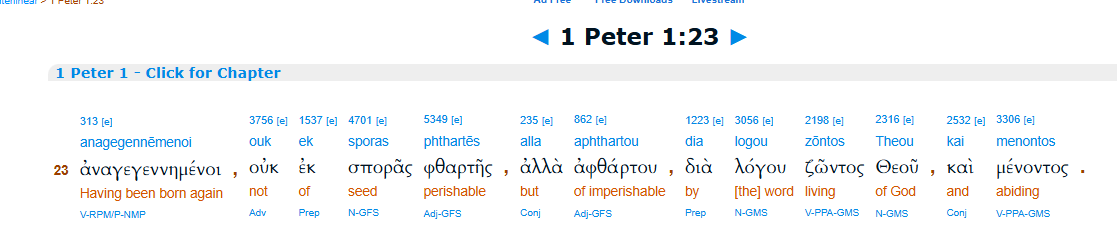
It's the Genitive case once again, meaning it's attributing relationship or possession of another nearby noun, in this case it's "Θεοῦ" or "Theou" meaning "Word of God" — Jesus Christ. The verses leading up to it lay out that it was Jesus who was "made manifest in the last times" and "through him [we] are believers in God". With the descriptive verbs "Living" and "Abiding" being used here with it, as they were similarly in Hebrews 4:12, it's pretty clear this is not meant to refer to a book or scripture as a whole but to the God-Man Jesus Christ.
The Other Word ῥῆμα (rhéma)
In other places of the New Testament, you will see usages of "word" or "words" that are actually a different Greek word than Logos. That word is "ῥῆμα" or "rhéma". If we refer to Bible Hub's page for the word, it appears to be different in nature than the Logos we discussed before. It's defined as:
- an utterance (individually, collectively or specially)
- (by implication) a matter or topic
- (especially) of narration, command or dispute
- (with a negative) naught whatever
It's like a spoken word, rather than Logos where it's more Philosophical than that. If there are two words for "word", perhaps they should have two different meanings.
Peter Helps Defines the other "word", ῥῆμα (rhéma) for us
Continuing into 1 Peter 1:25, we see the second usage of "word" in most translations, this time it's a quotation from Isaiah 40. Peter is quoting from the Septuagint here, and "the word of the Lord" here is actually "ῥῆμα τοῦ θεοῦ ἡμῶν" or "rhēma tou theou hēmōn". Let's take a look at Isaiah 40:5-8 and see what we find.
Excerpt taken from the Swete's Septuagint on Bible Hub, emphasis added:
5 καὶ ὀφθήσεται ἡ δόξα Κυρίου, καὶ ὄψεται πᾶσα σὰρξ τὸ σωτήριον τοῦ θεοῦ, ὅτι Κύριος ἐλάλησεν.
The Word of the Lord Stands Forever
6 φωνὴ λέγοντος Βόησον. καὶ εἶπα Τί βοήσω; Πᾶσα σὰρξ χόρτος, καὶ πᾶσα δόξα ἀνθρώπου ὡς ἄνθος χόρτου· 7 ἐξηράνθη ὁ χόρτος καὶ τὸ ἄνθος ἐξέπεσεν, 8 τὸ δὲ ῥῆμα τοῦ θεοῦ ἡμῶν μένει εἰς τὸν αἰῶνα.
Isaiah 40:5-8 (SAAS)
5 The glory of the Lord shall be revealed, and all flesh shall see the salvation of God; for the Lord has spoken.” 6 The voice said, “Cry out.” So I said, “What shall I cry?” “All flesh is grass, and all man's glory is like the flower of the field. 7 The grass withers, the flower fades, 8 but the word of our God abides forever.’
We see Isaiah is talking about something the Lord is revealing to us; That God's Glory shall be revealed (and as we already discussed, the Logos who is Jesus is that glory) and all flesh shall see the salvation of God "for the Lord has spoken". Then we get to verse 8 and we see that the Lord's "word" — rhēma — abides forever. Peter then immediately after the quotation clarifies what that "word" is.
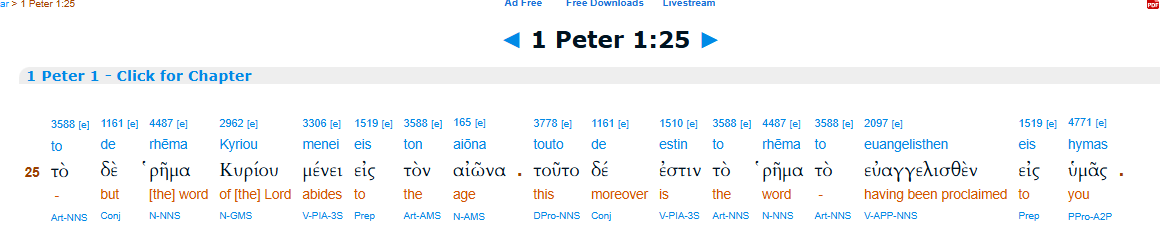
It's the word — rhēma — of the Gospel preached to you: "ῥῆμα τὸ εὐαγγελισθὲν εἰς ὑμᾶς"
And if we remember from Isaiah 40:5, It's the Glory of the Lord that is revealing the spoken word to us of the gospel. This is the exact pattern that Peter uses in his Epistle also; The Word of God — logos — who is Living and Abiding was made manifest in these last times for our sakes — having been raised from the dead by God and Given His glory — gave us the assurance of the Gospel preached to us. Then we read the quotation that reminds us that our own glory fades, but the promise of the Gospel of our God abides forever.
We need not look any further than what Jesus prayed the night of His betrayal to understand this pattern is one that makes sense to follow. In the High Priestly prayer, Jesus uses the same Greek words in the same order of logon which brings the rhēma.
John 17:1–6 (ESV)
The High Priestly Prayer 17 When Jesus had spoken these words, he lifted up his eyes to heaven, and said, “Father, the hour has come; glorify your Son that the Son may glorify you, 2 since you have given him authority over all flesh, to give eternal life to all whom you have given him. 3 And this is eternal life, that they know you, the only true God, and Jesus Christ whom you have sent. 4 I glorified you on earth, having accomplished the work that you gave me to do. 5 And now, Father, glorify me in your own presence with the glory that I had with you before the world existed. 6 “I have manifested your name to the people whom you gave me out of the world. Yours they were, and you gave them to me, and they have kept your word.
At the end of verse 6, the section translated "they have kept your word" the Greek literally says "the logon of You [the Father] they have Observed/Kept/Guarded [tetērēkan]" which — if we're being literal — is more than just God's teachings and extends to Jesus himself. Jesus' High Priestly Prayer follows the same pattern that the Greek version of Isaiah makes, and that Peter uses in 1 Peter 2:22-25. They all use the same Greek words in the same spots, if we keep reading Jesus' High Priestly Prayer, you will see what I mean
John 17:7–8 (ESV)
7 Now they know that everything that you have given me is from you. 8 For I have given them the words that you gave me, and they have received them and have come to know in truth that I came from you; and they have believed that you sent me.
In verse 8, "I have given them the words that you gave me" uses "ῥήματα" or "rhēmata" which is a form of the other type of "spoken word", and we received those words (the Gospel) and come to know that Jesus came from the Father, which is to say that He has the Glory of God even though He is a man. This once again follows the pattern that Isaiah and Peter used, showing us that this pattern seems to be a trustworthy one to acknowledge.
Jesus later asks the Father to "τήρησον" or "tērēson" us in His name, the same word Jesus used to say that the Apostles had kept God's logos. It's showing a loving relationship that goes beyond just following rules, or listening to the Gospel, but one that reveals God's nature to us in a way that's undeniable, that keeps/guards us as we reveal our own nature (our own word) to The Word — Jesus Christ — in our hearts.
The Pattern Holds deeper into the Old Testament
While looking to see if what I said in that last paragraph was something that makes sense biblically, I stumbled upon Proverbs 4. First we will read it in English, after we will compare it to some portions in the Greek.
Proverbs 4:1–6 (ESV)
A Father’s Wise Instruction
4 Hear, O sons, a father’s instruction, and be attentive, that you may gain insight, 2 for I give you good precepts; do not forsake my teaching. 3 When I was a son with my father, tender, the only one in the sight of my mother, 4 he taught me and said to me, “Let your heart hold fast my words; keep my commandments, and live. 5 Get wisdom; get insight; do not forget, and do not turn away from the words of my mouth. 6 Do not forsake her, and she will keep you; love her, and she will guard you.
Verses 4-6 are specifically interesting to us in the Greek:
4 οἳ ἔλεγον καὶ ἐδίδασκόν με Ἐρειδέτω ὁ ἡμέτερος λόγος εἰς σὴν καρδίαν· φύλασσε ἐντολάς, 5 μὴ ἐπιλάθῃ· μηδὲ παρίδῃς ῥῆσιν ἐμοῦ στόματος 6 μηδὲ ἐγκαταλίπῃς αὐτήν, καὶ ἀνθέξεταί σου· ἐράσθητι αὐτῆς, καὶ τηρήσει σε.
"Let your heart hold fast my (our in the case of the Greek) logos" — Word — followed by "do not turn away from the rhēsin emou stomatos" — words of my mouth. Here the Septuagint uses a primitive form of the word Peter defined for us as the gospel preached to us. As far back as the days of Solomon, we have this pattern of obedience to the Word of God, and the words preached by Him being two separate "words".
Skipping to verse 20 we have
Proverbs 4:20–27 (ESV)
        20       My son, be attentive to my words;
  incline your ear to my sayings.
        21       Let them not escape from your sight;
  keep them within your heart.
        22       For they are life to those who find them,
  and healing to all their flesh.
        23       Keep your heart with all vigilance,
  for from it flow the springs of life.
        24       Put away from you crooked speech,
  and put devious talk far from you.
        25       Let your eyes look directly forward,
  and your gaze be straight before you.
        26       Ponder the path of your feet;
  then all your ways will be sure.
        27       Do not swerve to the right or to the left;
  turn your foot away from evil.
20 υἱέ, ἐμῇ ῥήσει πρόσεχε, τοῖς δὲ ἐμοῖς λόγοις παράβαλε σὸν οὖς,
The first bolded word, we have "ῥήσει" or "rhēsei" which is again, an earlier form of the word "rhéma", the "spoken word" or "sayings". The second bolded word, we have another form of Logos — "λόγοις" or "logois" — which here translates to "words".
This verse roughly translates to: "My Son, to my sayings take heed, and to my words set aside your ear", it's reiterating essentially the same thing we heard in verses 4 and 5: Follow the teachings of the Lord Jesus, and listen to Him as He reveals God to us; Keep Him in your heart for He is life and healing to all flesh.
Colossians 3:15–17 (ESV)
15 And let the peace of Christ rule in your hearts, to which indeed you were called in one body. And be thankful. 16 Let the word of Christ dwell in you richly, teaching and admonishing one another in all wisdom, singing psalms and hymns and spiritual songs, with thankfulness in your hearts to God. 17 And whatever you do, in word or deed, do everything in the name of the Lord Jesus, giving thanks to God the Father through him.
Let the True nature, the logos of Christ, dwell in you richly. Whatever you do, in your "logo" that reveals your true nature or in your deeds, do it in the name of the Lord Jesus.