Moses Wrote of Me (Jesus), Part 2
In the first study of this series, I covered a parallel between the Old and New Testaments centered around the transfiguration.
Using this parallel, it can be demonstrated that Jesus was with the Israelites after the Exodus, but what if I told you that the Passover itself is also HUGE parallel for Jesus?
Background Context
Exodus 11:1 (ESV)
1 The LORD said to Moses, “Yet one plague more I will bring upon Pharaoh and upon Egypt. Afterward he will let you go from here. When he lets you go, he will drive you away completely.
God has just sent Moses to perform several signs and wonders before Pharaoh in an attempt to get him to release the people of Israel from slavery in Egypt. At each stage in the way, Pharaoh, and God, has hardened his heart to the will of God, so much that he will not listen any longer. God has decided a final plague is necessary to show them just how serious He is.
Exodus 11:4–10 (ESV)
4 So Moses said, “Thus says the LORD: ‘About midnight I will go out in the midst of Egypt, 5 and every firstborn in the land of Egypt shall die, from the firstborn of Pharaoh who sits on his throne, even to the firstborn of the slave girl who is behind the handmill, and all the firstborn of the cattle. 6 There shall be a great cry throughout all the land of Egypt, such as there has never been, nor ever will be again. 7 But not a dog shall growl against any of the people of Israel, either man or beast, that you may know that the LORD makes a distinction between Egypt and Israel.’ 8 And all these your servants shall come down to me and bow down to me, saying, ‘Get out, you and all the people who follow you.’ And after that I will go out.” And he went out from Pharaoh in hot anger. 9 Then the LORD said to Moses, “Pharaoh will not listen to you, that my wonders may be multiplied in the land of Egypt.”
10 Moses and Aaron did all these wonders before Pharaoh, and the LORD hardened Pharaoh’s heart, and he did not let the people of Israel go out of his land.
The Passover Preparation
In Exodus 12, we can read about how God instructed Moses on how Israel was to be safe from this final plague on Egypt, what we now refer to as "Passover" which will become abundantly clear as to why in a moment.
God instructs Moses on how every family in Israel should gather a lamb without blemish, and if a Lamb is too much for their household, to share it with their neighbors. Israel is to gather these Lambs together, and slaughter them at twilight. God then has some special instructions for what to do afterward:
Exodus 12:7 (ESV)
7 “Then they shall take some of the blood and put it on the two doorposts and the lintel of the houses in which they eat it.
I just want to point something out here the imagery that the Israelites would be witnessing from all of this. This is pretty gruesome, so bear with me, but in order to prepare the sacrificial lambs to eat it for the ceremonial purposes as prescribed, they would have to string these lambs up on wooden sticks probably above basins for the rest of the blood to drain out, and then afterward they basically butcher the Lamb, so the family could partake in the sacrifice.
I hope I don't need to tell you how similar that would appear to a crucifixion! They would enter into the temple (in the time of our Lord, not during the Exodus), to give their sacrifice for the passover, and they would witness hundreds, if not thousands of these "proto-crucified" lambs who had been sacrificed to passover the sins of Israel.
They have to take the blood from this lamb, splash some on the Altar signifying God's side of the covenant (again in the time of Jesus), and then paint some on their doorposts of the house in which they eat it. Finally, Israel also has to eat the sacrificial flesh of the lamb, it is significant and part of the passover. Let's read on to see why I say that.
Exodus 12:8 (ESV)
8 They shall eat the flesh that night, roasted on the fire; with unleavened bread and bitter herbs they shall eat it.
They have to eat the flesh that night roasted, with unleavened bread specifically. Now that is significant, because leaven signifies life, whereas a flatbread is "dead" metaphorically speaking. This entire feast is pointing them towards death, and their reliance on God in order to be saved from it.
Exodus 12:9 (ESV)
9 Do not eat any of it raw or boiled in water, but roasted, its head with its legs and its inner parts.
Again, bear with me as the imagery is a bit gruesome, but such is the nature of life and death which are the matters we speak of.
Keep that image of a crucifixion in your mind, and consider the highlighted portion. How would you roast an animal with its head, legs and inner parts? On a wooden spit, like a rotisserie chicken, or a pig roast likely! Yet another instance where God is telling Israel that this sacrificial lamb is placed on a stake.
If you go to the Wikipedia page for the Passover Sacrifice, as of writing in May 2026, there is an image taken in 2012 by a group of Jews practicing passover (sadly, they do this because they missed Jesus they believe they need to do this because they reject God's Son as their Messiah). They are roasting the sacrifice exactly how I described it, this tradition lives on today we see. Shamefully, Jesus Christ our Lord is a footnote on the Wikipedia page for it, perhaps it needs an edit? Not sure if Wikipedia accepts sermons or Bible Studies as empirical evidence though...
Not only would the patriarch of the family — who would be the one who brought the lamb into the temple to be sacrificed and see the other sacrificial lambs being "proto-crucified" and drained of their blood — he won't be the only one to see this, now his entire family will witness the sacrificial lamb be roasted on a spit like a crucifixion also.
This all to me feels like a primer pointing towards Christ and how he would eventually suffer and die to be their Perfect Passover Lamb many years later. I think this imagery is historically accurate, perhaps I'm incorrect, but it seems very likely intentional. Moses, is writing here of imagery that points to Jesus because God is telling him what to do of course! It's planned ahead this intentionally folks, and it was written and preserved by faithful men for our purposes to show us how beautiful and almighty our God is.
So they've been instructed on how to prepare the meal, now what are the instructions for eating it?
Exodus 12:10-13 (ESV)
10 And you shall let none of it remain until the morning; anything that remains until the morning you shall burn. 11 In this manner you shall eat it: with your belt fastened, your sandals on your feet, and your staff in your hand. And you shall eat it in haste. It is the LORD’s Passover.
12 For I will pass through the land of Egypt that night, and I will strike all the firstborn in the land of Egypt, both man and beast; and on all the gods of Egypt I will execute judgments: I am the LORD. 13 The blood shall be a sign for you, on the houses where you are. And when I see the blood, I will pass over you, and no plague will befall you to destroy you, when I strike the land of Egypt.
Later again, God reiterates it when he re-news the covenant with Israel later in Exodus. He restates the necessity of eating the meal with unleavened bread, and to not let any of it remain left over (Exodus 34:25). On a tangentially related note, my Greek manuscript translation of the Old Testament has a command in Exodus 12:10 to not break any of the bones of the lamb, whereas the Hebrew only has it in verse 46, something I will bring up when we get there.
Through these sacrifices, the flesh of the lamb being eaten, and the blood of the lamb being painted on the doorposts, God will pass over those who obey Him in Egypt and strike the firstborn of everyone who has not obeyed Him. Here Moses is instructed Israel to select their lambs, but pay attention to the type of branch he asks Israel to paint the doorposts with.
Exodus 12:21–25 (ESV)
21 Then Moses called all the elders of Israel and said to them, “Go and select lambs for yourselves according to your clans, and kill the Passover lamb. 22 Take a bunch of hyssop and dip it in the blood that is in the basin, and touch the lintel and the two doorposts with the blood that is in the basin. None of you shall go out of the door of his house until the morning. 23 For the LORD will pass through to strike the Egyptians, and when he sees the blood on the lintel and on the two doorposts, the LORD will pass over the door and will not allow the destroyer to enter your houses to strike you. 24 You shall observe this rite as a statute for you and for your sons forever. 25 And when you come to the land that the LORD will give you, as he has promised, you shall keep this service.
Jesus hung on the Doorway
If anyone was not sure what a doorpost and lintel is, here is a diagram to show you. Nowadays, we would probably refer to it as a "door frame".

It's a really common architecture feature of ancient structures and buildings, and we still do this, but we commonly hide it inside drywall or brick around the doorways. It's the frame (usually made of wood) around the door that we hang our doors on that makes virtually every entryway in any modern building.
So Israel was instructed to put some of the blood of the passover lamb on the two the doorposts and the lintel using a hyssop branch (Exodus 12:22) before entering into their home, and consuming the sacrifice (Exodus 12:7-9) in order to be protected from the last plague against Egypt (Exodus 12:13).
I want to tie this back to the New Testament and point something out in the imagery of the crucifixion, this yet again points towards Jesus Christ and how he would suffer as their Perfect Passover Lamb.
John 19:28–30 (ESV)
The Death of Jesus
28 After this, Jesus, knowing that all was now finished, said (to fulfill the Scripture), “I thirst.” 29 A jar full of sour wine stood there, so they put a sponge full of the sour wine on a hyssop branch and held it to his mouth. 30 When Jesus had received the sour wine, he said, “It is finished,” and he bowed his head and gave up his spirit.
In fulfillment — the "Antitype" from the Greek "ἀντίτυπον" in 1 Peter 3:21 translated as "corresponds" or "ἀντίτυπα τῶν ἀληθινῶν" in Hebrews 9:24 translated "copies of the true thing" — Jesus receives the sour wine painting the Lintel on the cross after painting the Two Doorposts with the blood dripping down from his pierced hands. He says "It is finished", fulfilling the Passover for all time, and laying down His life for many, and opening the door to Heaven for those who would believe in him.
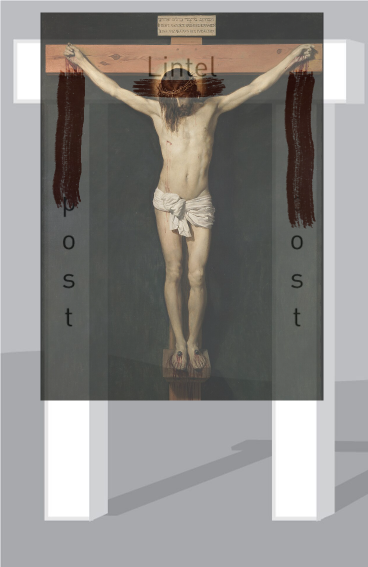
Don't believe me, let's look at a few more instances where Christ tells us plainly.
What do we hang on the Doorpost and Lintel?
We hang doors on them, yes I know a silly question since I answered it earlier. What did Jesus say he was again?
John 10:7–18 (ESV)
7 So Jesus again said to them, “Truly, truly, I say to you, I am the door of the sheep. 8 All who came before me are thieves and robbers, but the sheep did not listen to them. 9 I am the door. If anyone enters by me, he will be saved and will go in and out and find pasture. 10 The thief comes only to steal and kill and destroy. I came that they may have life and have it abundantly. 11 I am the good shepherd. The good shepherd lays down his life for the sheep. 12 He who is a hired hand and not a shepherd, who does not own the sheep, sees the wolf coming and leaves the sheep and flees, and the wolf snatches them and scatters them. 13 He flees because he is a hired hand and cares nothing for the sheep. 14 I am the good shepherd. I know my own and my own know me, 15 just as the Father knows me and I know the Father; and I lay down my life for the sheep. 16 And I have other sheep that are not of this fold. I must bring them also, and they will listen to my voice. So there will be one flock, one shepherd. 17 For this reason the Father loves me, because I lay down my life that I may take it up again. 18 No one takes it from me, but I lay it down of my own accord. I have authority to lay it down, and I have authority to take it up again. This charge I have received from my Father.”
Even when he tells us he is the door, he says "I will lay down my life for the sheep" pointing directly at the fact he is the ultimate sacrifice.
Now Israel had to paint their doorposts before they could enter into their Household to be protected from the last Plague during the Exodus. In the same way that the Lamb had to be sacrificed, and that Israel had to paint the doorpost and lintel, they painted the Cross with Jesus' blood so that the door could be opened to allow them to enter into Heaven. Jesus had to die in order for us to be saved, but that of course was not the end for him.
What did Israel eat alongside the flesh of Sacrificial Lamb?
Unleavened bread, not dissimilar from the Manna from Heaven they would end up eating in the wilderness every single day.
John 6:29–59 (ESV)
29 Jesus answered them, “This is the work of God, that you believe in him whom he has sent.” 30 So they said to him, “Then what sign do you do, that we may see and believe you? What work do you perform? 31 Our fathers ate the manna in the wilderness; as it is written, ‘He gave them bread from heaven to eat.’ ” 32 Jesus then said to them, “Truly, truly, I say to you, it was not Moses who gave you the bread from heaven, but my Father gives you the true bread from heaven. 33 For the bread of God is he who comes down from heaven and gives life to the world.” 34 They said to him, “Sir, give us this bread always.”
35 Jesus said to them, “I am the bread of life; whoever comes to me shall not hunger, and whoever believes in me shall never thirst. 36 But I said to you that you have seen me and yet do not believe. 37 All that the Father gives me will come to me, and whoever comes to me I will never cast out. 38 For I have come down from heaven, not to do my own will but the will of him who sent me. 39 And this is the will of him who sent me, that I should lose nothing of all that he has given me, but raise it up on the last day. 40 For this is the will of my Father, that everyone who looks on the Son and believes in him should have eternal life, and I will raise him up on the last day.”
41 So the Jews grumbled about him, because he said, “I am the bread that came down from heaven.” 42 They said, “Is not this Jesus, the son of Joseph, whose father and mother we know? How does he now say, ‘I have come down from heaven’?” 43 Jesus answered them, “Do not grumble among yourselves. 44 No one can come to me unless the Father who sent me draws him. And I will raise him up on the last day. 45 It is written in the Prophets, ‘And they will all be taught by God.’ Everyone who has heard and learned from the Father comes to me— 46 not that anyone has seen the Father except he who is from God; he has seen the Father. 47 Truly, truly, I say to you, whoever believes has eternal life. 48 I am the bread of life. 49 Your fathers ate the manna in the wilderness, and they died. 50 This is the bread that comes down from heaven, so that one may eat of it and not die. 51 I am the living bread that came down from heaven. If anyone eats of this bread, he will live forever. And the bread that I will give for the life of the world is my flesh.”
52 The Jews then disputed among themselves, saying, “How can this man give us his flesh to eat?” 53 So Jesus said to them, “Truly, truly, I say to you, unless you eat the flesh of the Son of Man and drink his blood, you have no life in you. 54 Whoever feeds on my flesh and drinks my blood has eternal life, and I will raise him up on the last day. 55 For my flesh is true food, and my blood is true drink. 56 Whoever feeds on my flesh and drinks my blood abides in me, and I in him. 57 As the living Father sent me, and I live because of the Father, so whoever feeds on me, he also will live because of me. 58 This is the bread that came down from heaven, not like the bread the fathers ate, and died. Whoever feeds on this bread will live forever.” 59 Jesus said these things in the synagogue, as he taught at Capernaum.
He is spamming the name of God revealed to Moses from the burning bush right in their faces throughout these passages. "Ἐγώ εἰμι", "I am the bread", could he be more obvious?
The New Passover Meal
To add insult to injury, if you did not believe Jesus that he was the bread from Heaven, or that he was giving his flesh as the new passover lamb, look at what he says when he institutes the Last Supper, and pay attention to the context, he's saying this during the passover meal!
Matthew 26:17–29 (ESV)
The Passover with the Disciples
17 Now on the first day of Unleavened Bread the disciples came to Jesus, saying, “Where will you have us prepare for you to eat the Passover?” 18 He said, “Go into the city to a certain man and say to him, ‘The Teacher says, My time is at hand. I will keep the Passover at your house with my disciples.’ ” 19 And the disciples did as Jesus had directed them, and they prepared the Passover.
20 When it was evening, he reclined at table with the twelve. 21 And as they were eating, he said, “Truly, I say to you, one of you will betray me.” 22 And they were very sorrowful and began to say to him one after another, “Is it I, Lord?” 23 He answered, “He who has dipped his hand in the dish with me will betray me. 24 The Son of Man goes as it is written of him, but woe to that man by whom the Son of Man is betrayed! It would have been better for that man if he had not been born.” 25 Judas, who would betray him, answered, “Is it I, Rabbi?” He said to him, “You have said so.”
Institution of the Lord’s Supper
26 Now as they were eating, Jesus took bread, and after blessing it broke it and gave it to the disciples, and said, “Take, eat; this is my body.” 27 And he took a cup, and when he had given thanks he gave it to them, saying, “Drink of it, all of you, 28 for this is my blood of the covenant, which is poured out for many for the forgiveness of sins. 29 I tell you I will not drink again of this fruit of the vine until that day when I drink it new with you in my Father’s kingdom.”
The Lamb was slain, and he instituted a meal that we eat in remembrance of what he did for us, the same way that God instituted the Passover Festival for the Jews to remember what he did for them back in the Exodus so let us never forget what Jesus Christ has done for us, and eat of his Passover Meal until we come into his Kingdom.
Contrast what Jesus did with what Moses instructed Israel to do in remembrance for all generations:
Exodus 13:3–10 (ESV)
The Feast of Unleavened Bread
3 Then Moses said to the people, “Remember this day in which you came out from Egypt, out of the house of slavery, for by a strong hand the LORD brought you out from this place. No leavened bread shall be eaten. 4 Today, in the month of Abib, you are going out. 5 And when the LORD brings you into the land of the Canaanites, the Hittites, the Amorites, the Hivites, and the Jebusites, which he swore to your fathers to give you, a land flowing with milk and honey, you shall keep this service in this month. 6 Seven days you shall eat unleavened bread, and on the seventh day there shall be a feast to the LORD. 7 Unleavened bread shall be eaten for seven days; no leavened bread shall be seen with you, and no leaven shall be seen with you in all your territory. 8 You shall tell your son on that day, ‘It is because of what the LORD did for me when I came out of Egypt.’ 9 And it shall be to you as a sign on your hand and as a memorial between your eyes, that the law of the LORD may be in your mouth. For with a strong hand the LORD has brought you out of Egypt. 10 You shall therefore keep this statute at its appointed time from year to year.
God instructed Israel to consume the sacrificial flesh of the Passover Lamb, and to take refuge in the house which was painted by the blood of said lamb to be safe from the plagues against Egypt. He also has instituted a Feast as a remembrance of what God had done for them.
Jesus gave us his body, that is the bread, and his blood, the wine, to open the doorway to the house in Heaven prepared for us and to protect us from the plagues against Spiritual Egypt, and he gives us the bread from Heaven to nourish us during our Exile in the wilderness that is the modern world, in remembrance of what he has done for us, while we await our inheritance.
More proof of Jesus as the Passover Lamb
Later on in Exodus 12, God dictates to Moses further rules for the Passover celebration since they will be venturing out of Egypt, and will have more variables at play when it comes to acceptable worship and remembrance of what God has done for them in Egypt.
Exodus 12:43–51 (ESV)
Institution of the Passover
43 And the LORD said to Moses and Aaron, “This is the statute of the Passover: no foreigner shall eat of it, 44 but every slave that is bought for money may eat of it after you have circumcised him. 45 No foreigner or hired worker may eat of it. 46 It shall be eaten in one house; you shall not take any of the flesh outside the house, and you shall not break any of its bones. 47 All the congregation of Israel shall keep it. 48 If a stranger shall sojourn with you and would keep the Passover to the LORD, let all his males be circumcised. Then he may come near and keep it; he shall be as a native of the land. But no uncircumcised person shall eat of it. 49 There shall be one law for the native and for the stranger who sojourns among you.”
50 All the people of Israel did just as the LORD commanded Moses and Aaron. 51 And on that very day the LORD brought the people of Israel out of the land of Egypt by their hosts.
First, I would like to point out in verse 46 the highlighted portion: "you shall not break any of its bones" in reference to the passover Lamb that is slain. In John, we see an important detail that is in fulfillment of prophecy, but it's also to show you even more how Jesus Christ is the New Passover Lamb.
John 19:31–37 (ESV)
Jesus’ Side Is Pierced
31 Since it was the day of Preparation, and so that the bodies would not remain on the cross on the Sabbath (for that Sabbath was a high day), the Jews asked Pilate that their legs might be broken and that they might be taken away. 32 So the soldiers came and broke the legs of the first, and of the other who had been crucified with him. 33 But when they came to Jesus and saw that he was already dead, they did not break his legs. 34 But one of the soldiers pierced his side with a spear, and at once there came out blood and water. 35 He who saw it has borne witness—his testimony is true, and he knows that he is telling the truth—that you also may believe. 36 For these things took place that the Scripture might be fulfilled: “Not one of his bones will be broken.” 37 And again another Scripture says, “They will look on him whom they have pierced.”
Not only is Christ's bones not broken like the Passover Lamb, he is speared similarly to how the Passover Lamb would have to be cooked. This obviously is not to say the imagery is identical, and this passage actually much deeper than what I've described — as John alludes it's to fulfill other scripture unrelated to this study I will not be discussing today.
Further Connections with the Lord's Supper
God instituted a key distinction for who is allowed to eat of the Passover Sacrifice. It's not for foreigners (that is, not from the people of Israel by blood in this case), and it's not for hired workers who are not a part of your family. In Ancient cultures, slaves were not like what we think of when we hear slavery, they were much closer to members of the household than they were in more modern examples.
As such, God has allowed Slaves who are circumcised — that is to say, they are members of God's covenant by adoption just like the Gentiles later became members of the household of God — to eat of the Passover Meal with the family. He also has included the sojourner which is basically a temporary resident, on the condition he and all "his males" — meaning immediate relatives and household slaves too — as a sign of the covenant with God, they too are allowed to eat of the Passover Meal.
Now why do I say this connects to the Lord's Supper? Well, Let's read what Paul wrote in his letter to the Corinthians who had been redeemed from all manners of Idolatry and sacrificial food was the norm for them. The Corinthians could be said to be like the Sojourners who are joined to Israel via the circumcision of the heart by the baptism of the Holy Spirit. Paul tells them in his letter that the participants in the altar of an Idol are participants in the altar of demons, and they cannot partake in the Lord's supper because it's also a sacrifice.
1 Corinthians 8:4–11 (ESV)
4 Therefore, as to the eating of food offered to idols, we know that “an idol has no real existence,” and that “there is no God but one.” 5 For although there may be so-called gods in heaven or on earth—as indeed there are many “gods” and many “lords”— 6 yet for us there is one God, the Father, from whom are all things and for whom we exist, and one Lord, Jesus Christ, through whom are all things and through whom we exist.
7 However, not all possess this knowledge. But some, through former association with idols, eat food as really offered to an idol, and their conscience, being weak, is defiled. 8 Food will not commend us to God. We are no worse off if we do not eat, and no better off if we do. 9 But take care that this right of yours does not somehow become a stumbling block to the weak. 10 For if anyone sees you who have knowledge eating in an idol’s temple, will he not be encouraged, if his conscience is weak, to eat food offered to idols? 11 And so by your knowledge this weak person is destroyed, the brother for whom Christ died.
Paul is showing them that eating of the sacrifice is a sign not to just yourself, but to the conscience of everyone around you also. In the same way, a wicked man known to the community partaking in the Lord's Supper and not changing his heart through submission to the Holy Spirit is an ugly stain on the reputation of the Church. In the same way, Paul warns them not to be like those in the wilderness who disobeyed God and did the same things.
1 Corinthians 10:1-5 (ESV)
Warning Against Idolatry
10 For I do not want you to be unaware, brothers, that our fathers were all under the cloud, and all passed through the sea, 2 and all were baptized into Moses in the cloud and in the sea, 3 and all ate the same spiritual food, 4 and all drank the same spiritual drink. For they drank from the spiritual Rock that followed them, and the Rock was Christ. 5 Nevertheless, with most of them God was not pleased, for they were overthrown in the wilderness.
He lays out that the example was made of those in the wilderness for our own sake, and that the sacrifices made by Pagans to the Idols are actually made to Demons. In the same way, the Lord's supper is viewed as a sacrifice pleasing to God on our own behalf.
1 Corinthians 10:6–22 (ESV)
6 Now these things took place as examples for us, that we might not desire evil as they did. 7 Do not be idolaters as some of them were; as it is written, “The people sat down to eat and drink and rose up to play.” 8 We must not indulge in sexual immorality as some of them did, and twenty-three thousand fell in a single day. 9 We must not put Christ to the test, as some of them did and were destroyed by serpents, 10 nor grumble, as some of them did and were destroyed by the Destroyer. 11 Now these things happened to them as an example, but they were written down for our instruction, on whom the end of the ages has come. 12 Therefore let anyone who thinks that he stands take heed lest he fall. 13 No temptation has overtaken you that is not common to man. God is faithful, and he will not let you be tempted beyond your ability, but with the temptation he will also provide the way of escape, that you may be able to endure it.
14 Therefore, my beloved, flee from idolatry. 15 I speak as to sensible people; judge for yourselves what I say. 16 The cup of blessing that we bless, is it not a participation in the blood of Christ? The bread that we break, is it not a participation in the body of Christ? 17 Because there is one bread, we who are many are one body, for we all partake of the one bread. 18 Consider the people of Israel: are not those who eat the sacrifices participants in the altar? 19 What do I imply then? That food offered to idols is anything, or that an idol is anything? 20 No, I imply that what pagans sacrifice they offer to demons and not to God. I do not want you to be participants with demons. 21 You cannot drink the cup of the Lord and the cup of demons. You cannot partake of the table of the Lord and the table of demons. 22 Shall we provoke the Lord to jealousy? Are we stronger than he?
So Paul even is warning them, do not partake in the sacrifices to demons and the Lord's Supper because it is spiritual food and that it would provoke the Lord to Jealousy because the food sacrificed to Idols is also a spiritual food.
Consider the foreigners and rebellious of Israel in the time of the Exodus: Would they not also be participants in the altar of demons?
If we keep reading, Paul re-iterates the tradition of the Lord's Supper he received to the Corinthians, but it includes a warning afterward that not every person takes proper heed of I think:
1 Corinthians 11:23–32 (ESV)
23 For I received from the Lord what I also delivered to you, that the Lord Jesus on the night when he was betrayed took bread, 24 and when he had given thanks, he broke it, and said, “This is my body, which is for you. Do this in remembrance of me.” 25 In the same way also he took the cup, after supper, saying, “This cup is the new covenant in my blood. Do this, as often as you drink it, in remembrance of me.” 26 For as often as you eat this bread and drink the cup, you proclaim the Lord’s death until he comes.
27 Whoever, therefore, eats the bread or drinks the cup of the Lord in an unworthy manner will be guilty concerning the body and blood of the Lord. 28 Let a person examine himself, then, and so eat of the bread and drink of the cup. 29 For anyone who eats and drinks without discerning the body eats and drinks judgment on himself. 30 That is why many of you are weak and ill, and some have died. 31 But if we judged ourselves truly, we would not be judged. 32 But when we are judged by the Lord, we are disciplined so that we may not be condemned along with the world.
God bless you all!